

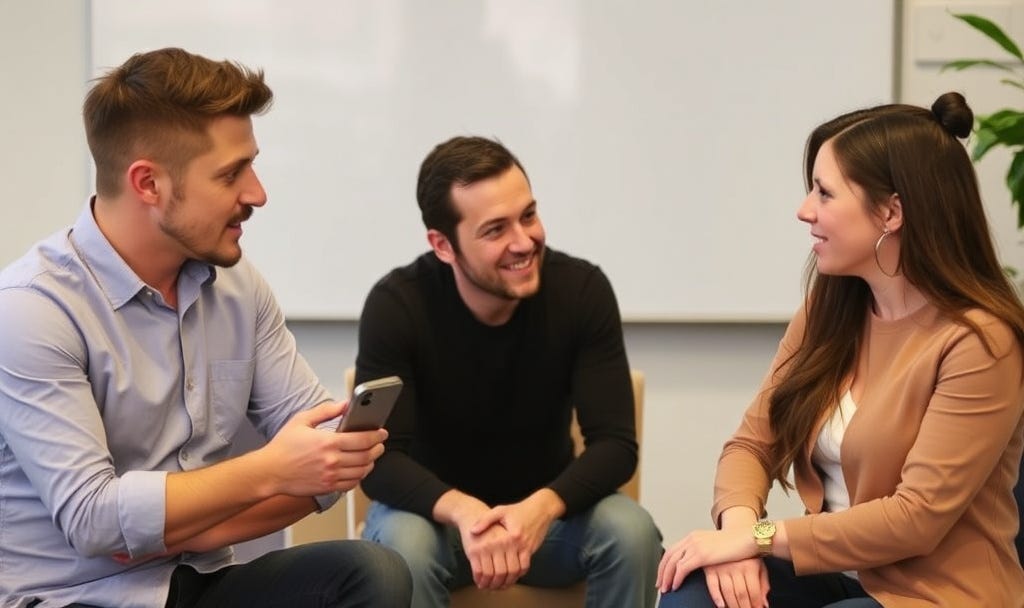
There was a sentence I never imagined hearing another grown man say.
“So, I flew to another city this weekend for a dating boot camp where they taught us how to introduce ourselves to women.”
I laughed, but not because it was ridiculous, although, admittedly, it sounded like the setup for a sitcom, but because my brain immediately pictured my grandfather’s reaction. He grew up in an era when men fixed things with duct tape, pliers, and a stubborn refusal to ask for directions. If I’d told him I spent two days and a couple thousand dollars learning how to say, “Hi, my name is Devin,” he would’ve looked at me the way people look at smoke coming out of a toaster. A little confused and slightly concerned. Then he would’ve shrugged, gone back to repairing the lawnmower, and probably muttered, “Just go talk to her.”
Except that’s exactly the point.
For a growing number of people, “just go talk to her” isn’t simple anymore. It feels terrifying.
The first time I heard about these dating boot camps, I assumed they were teaching manipulative pickup tricks or rehearsed lines designed to impress strangers. Many of them aren’t selling confidence as much as they’re teaching something far more basic. How to make eye contact without immediately looking away. How to walk toward another human being instead of around them. How to start a conversation that doesn’t sound rehearsed. How to handle rejection without believing it says something permanent about your worth.
Think about that for a moment.
We’ve reached a point in history where adults are paying experts to teach them skills that previous generations learned simply by living their lives, and before we laugh too hard, I don’t think this says nearly as much about those men as it does about the world we’ve built.
My grandparents met because their lives naturally overlapped. They lived in the same town, attended the same church, and knew many of the same families. If they didn’t meet there, they might have crossed paths at the grocery store, the county fair, a neighborhood cookout, or because someone’s mother insisted, “You really ought to meet my friend’s daughter.” Even if romance never happened, they were constantly practicing something we’ve quietly lost… talking to people they didn’t already know.
Nobody called it optimizing social skills. It was simply called Thursday because conversation wasn’t an event, but rather woven into ordinary life. You chatted while waiting in line, lingered on front porches after dinner, borrowed a cup of sugar from next door, and somehow ended up talking for twenty minutes. Kids knocked on doors asking if someone wanted to play. Adults wandered into one another’s garages just to see what they were working on. There were awkward silences, of course. There were people who were shy, but the world kept creating opportunities to practice. You didn’t have to be socially gifted because society itself acted like training wheels.
Today, those training wheels have quietly disappeared.
Almost every inconvenience that once forced us to interact with another person has been redesigned out of existence. We order groceries from our couch, check ourselves out at the grocery store, scan boarding passes without speaking to a gate agent, ask Google instead of asking a stranger for directions, and text instead of calling because calling now feels strangely intrusive while also sitting in waiting rooms staring at our phones instead of making small talk with the person next to us or wearing headphones in public that politely announce, “Please don’t interrupt my podcast.”
Each one of those changes makes perfect sense on its own.
Together, they’ve transformed daily life into something our great-grandparents would barely recognize. We’ve built an incredibly efficient world, but efficiency has a funny way of eliminating the little moments that once made us feel connected. Every app saves us a few minutes. Every automation removes one more conversation. None of it seems significant until you zoom out and realize you’ve gone an entire week without talking to someone you didn’t already know.
Then we wonder why introducing ourselves to a stranger feels like standing on the edge of a cliff. We often tell ourselves that people have become less friendly. I’m not convinced that’s true. I think people are simply out of practice.
There’s an important difference.
The desire for connection hasn’t disappeared. If anything, survey after survey tells us people feel lonelier than they have in decades. The problem isn’t that we’ve stopped wanting relationships. It’s that we’ve unintentionally designed lives that require fewer opportunities to build them. That realization changes how I think about those dating boot camps. At first, they seemed almost absurd. Now they seem strangely understandable. They’re not really teaching dating. They’re offering physical therapy for social muscles that haven’t been used in years.
Confidence isn’t something you’re born with. It’s something you accidentally develop through repetition, but if you’ve spent years avoiding those moments, not because you’re lazy, but because modern life rarely requires them anymore, of course, saying hello starts to feel like public speaking.
We’ve mistaken exposure for personality. We assume socially confident people possess some mysterious gift, when in reality, many of them simply had more opportunities to practice, and maybe that’s the part that makes me pause.
It’s easy to poke fun at the guy who spends a weekend learning how to approach someone at a coffee shop. It’s much harder to admit that he’s responding to a problem many of us are quietly experiencing. We complain about loneliness while living increasingly isolated lives. We say community matters, yet we’ve organized our days so efficiently that we can move from morning to night without needing another person for almost anything. We celebrate convenience because convenience is wonderful, but convenience doesn’t ask about your day. Convenience doesn’t notice when you’re struggling. Convenience doesn’t become your friend; people do.
So perhaps the answer isn’t another app or another algorithm promising to match us with the perfect person. Maybe it’s deciding to make ourselves just a little more interruptible. Looking up instead of down, talking to the cashier, even though self-checkout is faster. None of those actions will transform society overnight, but that’s how every friendship, every romance, every community has always begun, with two imperfect people willing to risk the smallest act of vulnerability.
It’s remarkable that we’ve made that feel so difficult, but even more remarkable that we can still get it back.
Until next time, stay curious. Be kind. Build better communities & workplaces.
— Devin
Before You Go...
This newsletter explores the psychology of work, leadership, and what it means to be human in a world that’s moving faster every day.
My full-time work is helping organizations build healthier cultures through research-backed keynotes, leadership programs, and consulting. Every article you read here is connected to conversations I’m having with leaders around the country.
If your organization is wrestling with burnout, connection, trust, culture, or leading through change, let’s talk. I’d be happy to learn more about your team and see if I can help.
On the rare occasion I make eye contact with someone who's not listening to earbuds I will say hello. Some people look surprised that I spoke to them, probably because I interrupted their electronic trance.